Clean Architecture in Flutter: Why It Matters

The Problem
Flutter makes it incredibly easy to build applications. In just a few hours, you can have authentication, API calls, local storage, and multiple screens working together.
The challenge comes as the application grows.
What starts as a simple app with a few screens soon expands to include features like payments, notifications, offline support, analytics, and dozens of API endpoints. Without a clear structure, widgets gradually take on multiple responsibilities. They fetch data, parse JSON, handle business logic, validate input, manage navigation, and update the UI.
Over time, this creates tightly coupled code where a change in one feature can unexpectedly affect several others. The app still works, but it becomes increasingly difficult to maintain, test, and extend.
This is exactly the problem Clean Architecture is designed to solve.
The Solution
Rather than organizing code by features or folders alone, Clean Architecture organizes an application by responsibility.
Each layer has a single purpose, and clear boundaries prevent implementation details from leaking throughout the application.
Its core principle is simple:
Business logic should not depend on Flutter, external services, or implementation details.
Flutter is simply the framework used to present your application. The business rules should remain independent of the UI, backend, or storage solution.
The Three Layers
Presentation
The Presentation layer handles everything related to the user interface:
Screens and widgets
User interactions
State management (Bloc, Cubit, Riverpod, Provider, GetX, etc.)
Its job is to display data and respond to user actions, not to contain business logic or communicate directly with APIs.
Domain
The Domain layer contains the application's business rules.
It defines what the application does, regardless of how it's implemented. Whether it's authenticating a user, validating an order, or calculating a payment, these rules remain independent of Flutter, databases, and networking.
Because of this separation, the Domain layer is reusable, framework independent, and easy to test.
Data
The Data layer is responsible for interacting with external systems such as REST APIs, GraphQL, Firebase, SQLite, Hive, or secure storage.
Its role is to retrieve, store, and transform data before exposing it to the rest of the application.
Changing your backend or storage solution should only require changes in this layer.
How the Layers Work Together
Communication flows in one direction:
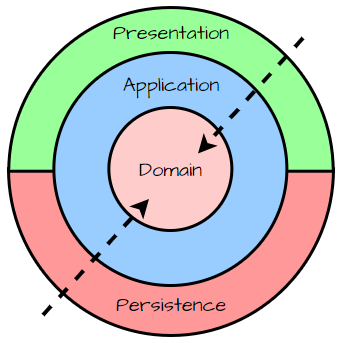
The Presentation layer requests an action. The Domain layer decides what should happen. The Data layer retrieves or persists the required data.
Each layer only knows about its own responsibility, keeping the application modular and easy to reason about.
Flutter Is Flexible, The Architecture Shouldn't Be
One of the biggest advantages of Clean Architecture is that it isn't tied to any specific Flutter technology.
Whether you use Bloc, Riverpod, Provider, or GetX for state management, or Firebase, REST, GraphQL, SQLite, or Hive for data, the overall architecture remains the same.
The tools may change, but the responsibilities of each layer do not.
Benefits of Clean Architecture
Maintainability: Changes are isolated to the appropriate layer.
Scalability: New features can be added without increasing complexity.
Testability: Business logic can be tested independently of Flutter.
Technology Independence: Swapping APIs, databases, or state management solutions requires minimal changes.
Collaboration: Teams can work on different layers with fewer conflicts.
Conclusion
Clean Architecture isn't about creating more folders or adding unnecessary complexity. It's about managing complexity as your application grows.
By separating Presentation, Domain, and Data, you create Flutter applications that are easier to understand, test, maintain, and evolve over time. Regardless of the state management or backend technologies you choose, these principles remain the same, making your codebase more resilient to change and far easier to scale.